
Why ASTM B117 Alone Shouldn’t Be Used to Predict Coating Performance
ASTM B117 salt spray testing has long been an industry standard for evaluating corrosion resistance. However, decades of research have shown that the test has little correlation to how protective coatings perform in real world environments.
For HVAC equipment exposed to coastal, industrial, marine, or other corrosive conditions, cyclic corrosion testing methods such as ISO 12944-9 provide a much more realistic indication of long term coating performance. Understanding the differences between these testing standards can help engineers, OEMs, and facility managers make more informed coating decisions.
Does ASTM B117 accurately predict real world corrosion performance?
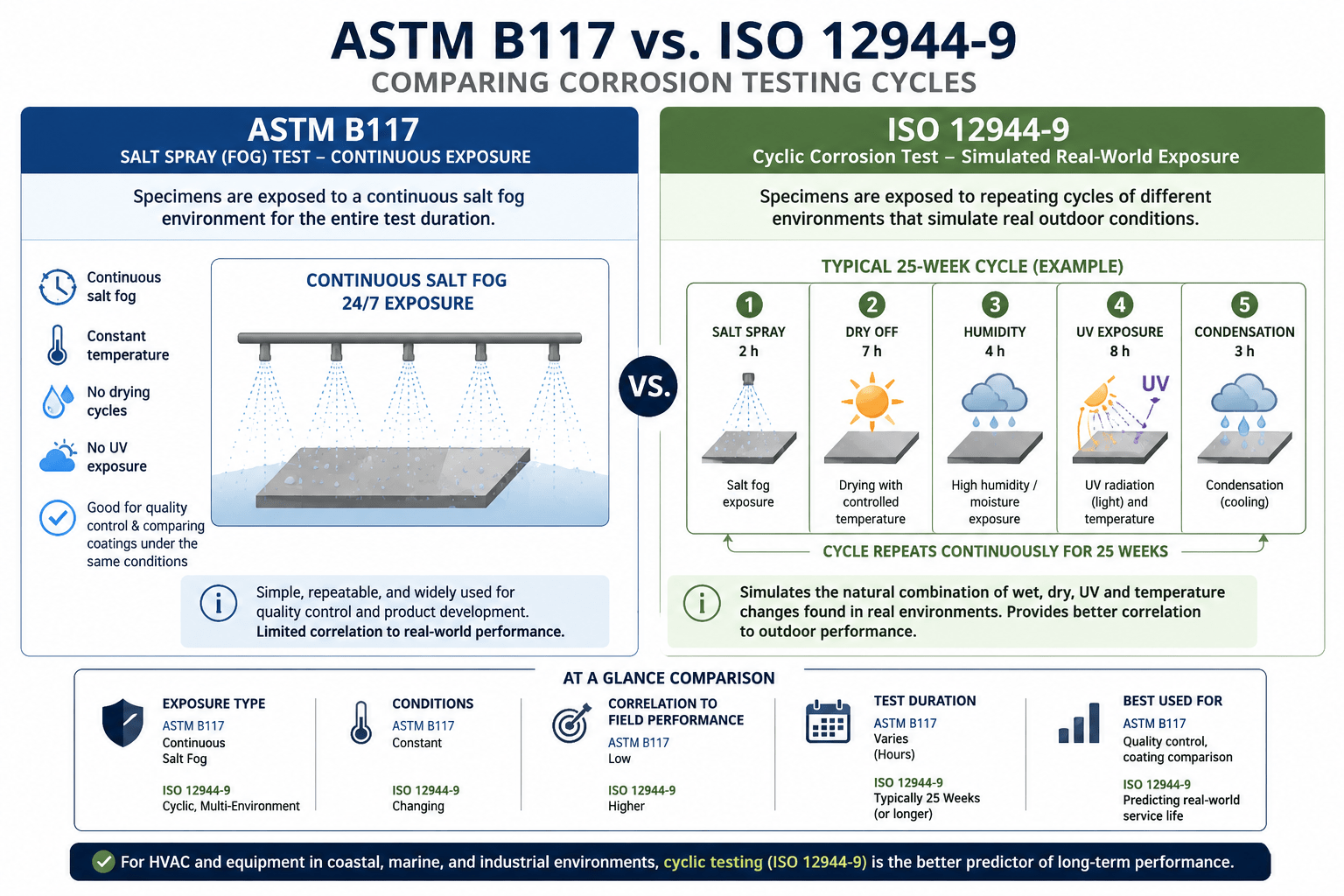
No. ASTM B117 exposes coated samples to continuous salt fog under controlled laboratory conditions. While useful for quality control and comparing coatings tested under identical conditions, it does not replicate the changing environmental conditions equipment experiences in the field. Modern cyclic corrosion testing, including ISO 12944-9, better simulates actual service conditions by incorporating wet and dry cycles, salt exposure, humidity, temperature changes, and UV exposure.
What Is ASTM B117?
Developed in the 1930s, ASTM B117 is one of the oldest and most widely recognized corrosion testing standards. During the test, coated panels are continuously exposed to a salt fog environment for a specified period of time.
Because the testing conditions remain constant throughout the test, ASTM B117 provides a repeatable method for comparing coatings under identical laboratory conditions.
The test is commonly used for:
While valuable for these purposes, ASTM B117 was never intended to accurately predict service life in outdoor environments.
Why ASTM B117 Does Not Reflect Real World Conditions
Equipment operating outdoors is exposed to constantly changing environmental conditions, including:
ASTM B117 subjects coated samples to continuous salt fog without allowing coatings to dry or experience changing environmental conditions.
Numerous studies have demonstrated that results from ASTM B117 often have little statistical correlation with actual atmospheric corrosion performance. Simply achieving more salt spray hours does not necessarily mean a coating will provide longer service life in the field.
How ISO 12944-9 Better Simulates Real World Exposure
Recognizing the limitations of traditional salt spray testing, the coatings industry developed more advanced cyclic corrosion testing methods.
ISO 12944-9 subjects coated samples to repeating cycles that more closely resemble actual environmental exposure.
These cycles may include:
Because coatings expand, contract, absorb moisture, and dry throughout their service life, cyclic testing provides a much more representative evaluation of long term corrosion resistance.
Why This Matters for HVAC Equipment
HVAC systems installed near coastlines, wastewater treatment facilities, chemical plants, food processing operations, and industrial manufacturing sites face aggressive corrosive environments every day.
Selecting a coating based solely on ASTM B117 salt spray hours may not provide an accurate picture of how that coating will perform over years of service.
Choosing coatings that have been validated using realistic cyclic corrosion testing can help:
Heresite’s Approach to Corrosion Testing
At Heresite, we believe coating performance should be validated using testing methods that closely reflect real operating conditions. In addition to ASTM B117, Heresite evaluates coatings using ISO 12944-9 and other industry recognized corrosion testing standards that better simulate the demanding environments HVAC equipment experiences throughout its service life. This approach provides engineers, OEMs, contractors, and building owners with greater confidence that coating performance will extend beyond laboratory testing and into real world applications.
Frequently Asked Questions
Is ASTM B117 still useful?
Yes. ASTM B117 remains an important quality control tool for comparing coatings tested under identical conditions. However, it should not be used by itself to predict long term outdoor performance.
Why is cyclic corrosion testing considered more realistic?
Cyclic testing incorporates changing environmental conditions including salt exposure, drying, humidity, and temperature fluctuations that better represent actual service environments.
Can salt spray hours predict coating lifespan?
No. Longer salt spray exposure does not automatically translate into longer service life because continuous salt fog does not accurately replicate real world operating conditions.
Which corrosion test is best for HVAC equipment?
For equipment operating in coastal, marine, or industrial environments, cyclic corrosion testing such as ISO 12944-9 generally provides a better indication of long term coating performance than ASTM B117 alone.
Learn More About Corrosion Protection
Selecting the right corrosion testing standard is just as important as selecting the right protective coating. If you’re evaluating coatings for HVAC equipment operating in corrosive environments, Heresite’s technical experts can help you understand which testing methods best match your application.
Explore our HVAC Protective Coatings, learn more about our corrosion testing process, or contact our team to discuss your project.